
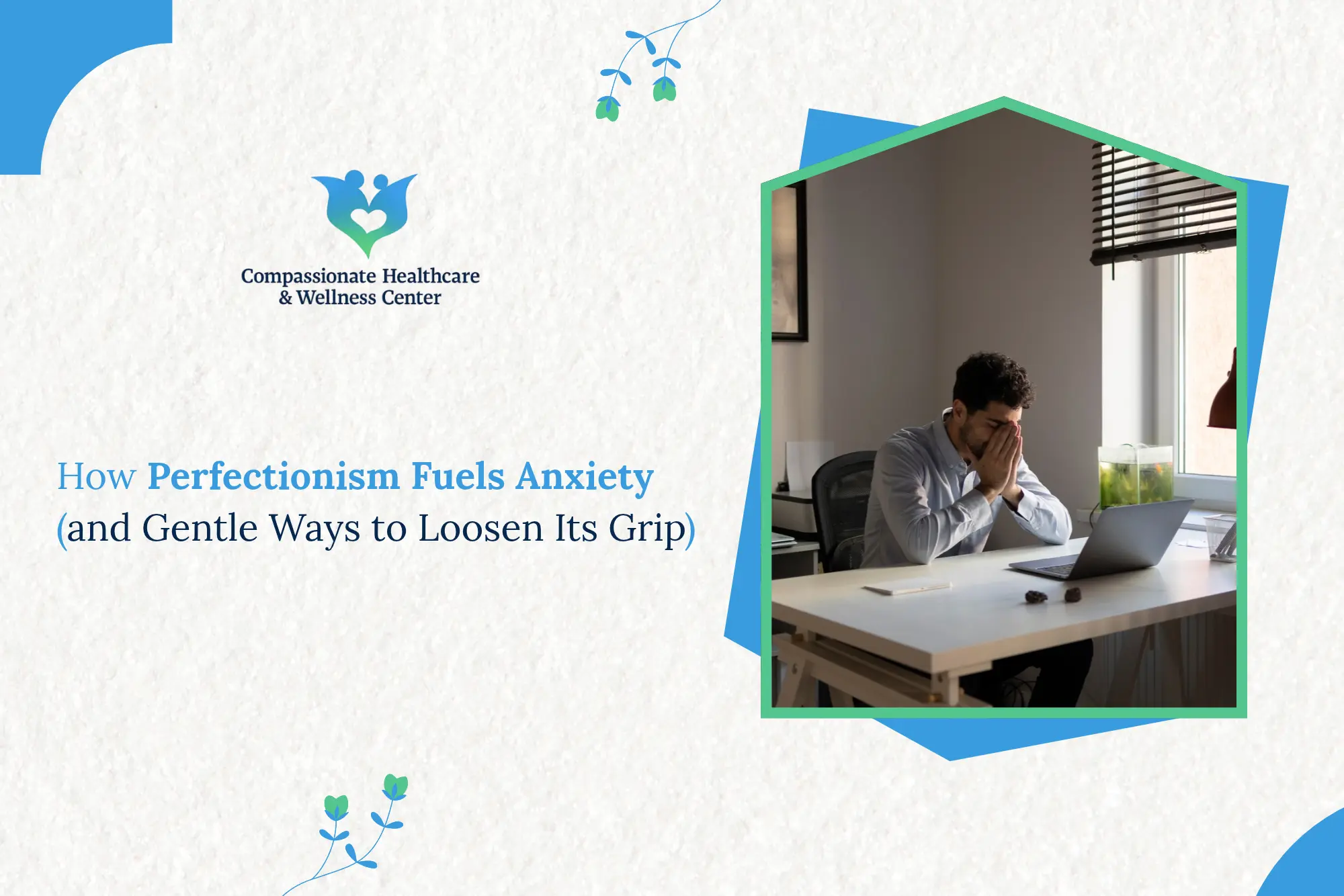
You care about doing things well. You want your career, your relationships, and your daily activities to be mindful and caring. That desire is not the problem. The problem starts when “doing well” subtly slides into “it must be perfect or it doesn’t count.” All of a sudden, every chore is heavier. Mistakes seem dangerous. Rest feels unearned. The mind is always on the lookout, always on guard for whatever is missing. This is how perfectionism feeds anxiety. They typically go hand in hand and make each other stronger.
Understanding the connection and finding gentler ways to respond can offer significant relief without you having to reduce your expectations or stop caring.
How Perfectionism and Anxiety Feed Each Other
Perfectionism is more than having high standards. It’s the assumption that anything less than perfect is not good enough and your value is contingent on attaining those unachievable standards. Anxiety is the body and mind’s response to that strain. The nervous system is aroused by the fear of making a mistake, being judged, or falling short.
It’s a lot of all-or-nothing thinking. A project is either excellent or a failure. A talk is either a great handling or a disaster. There is not much place for “good enough” or “progress.” This black-and-white prism converts the regular human experiences of feedback, little mistakes, and unfinished tasks into threats. The mind then goes into overdrive to prevent those threats, resulting in further concern, over-preparation, procrastination, or repeated revising.
There is often self-criticism. When anything falls short of internal standards, the inner voice might become harsh. That criticism creates additional worry, which reinforces the need to try harder next time. The loop continues: strive, fall short of perfection, criticize, feel anxious, strive again. This habit, over time, saps vitality from the system, makes it less fun, and can make even the most purposeful activity feel like a burden.
Recognizing the Signs in Daily Life
Perfectionism doesn’t necessarily appear as overt striving. It can manifest as trouble getting started on things because the result might not be perfect enough. It could manifest as procrastinating on choices, rewriting emails over and over, or avoiding situations where you might not be your best self. Some people experience physical stress, racing thoughts before big events, or a chronic feeling of being behind even when they’re objectively performing well.
It can affect relationships, too. The same high standards that apply to oneself may discreetly apply to others, or being afraid of letting people down can lead to people-pleasing and difficulties setting limits. The first step toward transformation is seeing these tendencies with curiosity rather than with more self-judgment.
Gentle Ways to Loosen Perfectionism’s Grip
The point isn’t to get sloppy or to forsake brilliance. It is to generate more flexibility so that high standards no longer have to be always accompanied by concern. Small systematic changes are often more effective than big changes.
Practice Self-Compassion as a Skill
Self-compassion is often mistaken for letting yourself off the hook. In practice, it’s a softer, more consistent kind of accountability. Notice the automatic critical thinking when a mistake is made, or a standard is not fulfilled. Then intentionally respond the way you would to a good friend in the same situation.
You can remark to yourself, “This is hard, and it’s okay to feel disappointed. Everybody has a hard time sometimes.” Try delivering this kindness with a hand on your heart or a slower breath to help calm the nervous system. Over time, dialing down self-criticism takes away the fuel that keeps anxiety burning.
Experiment with “Good Enough”
The brain learns that the feared catastrophe seldom comes by deliberately practicing imperfection in low-stakes scenarios. Choose a tiny item. Instead of 5 rounds of edits, send that email after 1 round of thoughtful edits. Instead of doing that home chore, leave it undone overnight. Instead of waiting till your idea is polished, share it.
Be aware of the anxiety that occurs, and stay with the experience long enough to understand that the conclusion is typically bearable. The point of these trials is not to do poor work. They are about teaching the nervous system that imperfect does not equal unsafe. Start with areas where the real-world consequences are limited. Then extend progressively.
Challenge All-or-Nothing Thoughts
When the mind declares that something is perfect or useless, take a stop and look for the middle ground. Ask: What would be “good enough” here? What’s the price of a slight imperfection? What would I say to a friend who thought the same?
Writing out the original concept and a more balanced alternative might create some distance. The perfectionistic notion may still arise, but it doesn’t have to dictate every action anymore. It breaks the instinctive association of high standards with anxiety.
Ground the Body When Anxiety Rises
Often, perfectionism shows up in the body as tension, tightness in the shoulders, shallow breathing, or a racing heart. Easy grounding strategies can stop the spiral. Slow breathing, with an extended exhale, feeling your feet on the ground, or temporarily tensing and releasing muscle groups, tells the nervous system that it’s safe.
These habits do not take away the desire to accomplish well. They lower the physical severity of the worry so that thinking can once again become clearer.
Orient Toward Values Instead of Perfection
If the urge to get decisions absolutely perfect seems to paralyze you, change the question. Instead of asking, “What is the right choice?” ask, “Which choice is more consistent with what I care about honesty, growth, connection, care?” Values steer us in the right direction without requiring perfection. This strategy maintains motivation but reduces the worry of pursuing an unattainable ideal.
When Extra Support Can Help
Some people discover that even with continuous self-help attempts, perfectionism and the anxiety it creates are still there. Therapy might be particularly helpful here. Strategies that emphasize mental processes, promote self-compassion, and progressively build tolerance for uncertainty might help people maintain their motivation while alleviating the taxing burden of perfectionism.
We help those who desire to break the cycle of perfectionism-anxiety at Compassionate Healthcare and Wellness Center. Our care is focused on practical tools, emotional insight, and establishing more sustainable methods of reacting to high standards and everyday demands.
Moving Toward Greater Ease
Perfectionism is typically started as a way to feel protected, appreciated, or in control. Over time, it can become a source of constant anxiety that restricts joy, rest, and connection. Loosening its grasp doesn’t entail losing grip on perfection. That is, making space for being human, but still caring strongly about what you do.
Start with one tiny experiment or one gentler inner response. See what happens when ‘good enough’ is allowed to breathe. Progress usually comes from repeated moderate practice rather than rapid transformation.
If perfectionism and anxiety are taking a toll on your day-to-day life, your sleep, your relationships, or your sense of calm, we are here at Compassionate Healthcare and Wellness Center.
Contact us to learn how to support you in holding onto your strengths and experiencing more freedom from the pressure to be perfect. You don’t have to carry that burden alone.
This post is for educational purposes only and does not replace professional mental health care. If perfectionism or anxiety is seriously impacting your well-being, you might want to consider speaking with a skilled clinician.